How to Grade a Trading Card: Centering, Corners, Edges & Surface
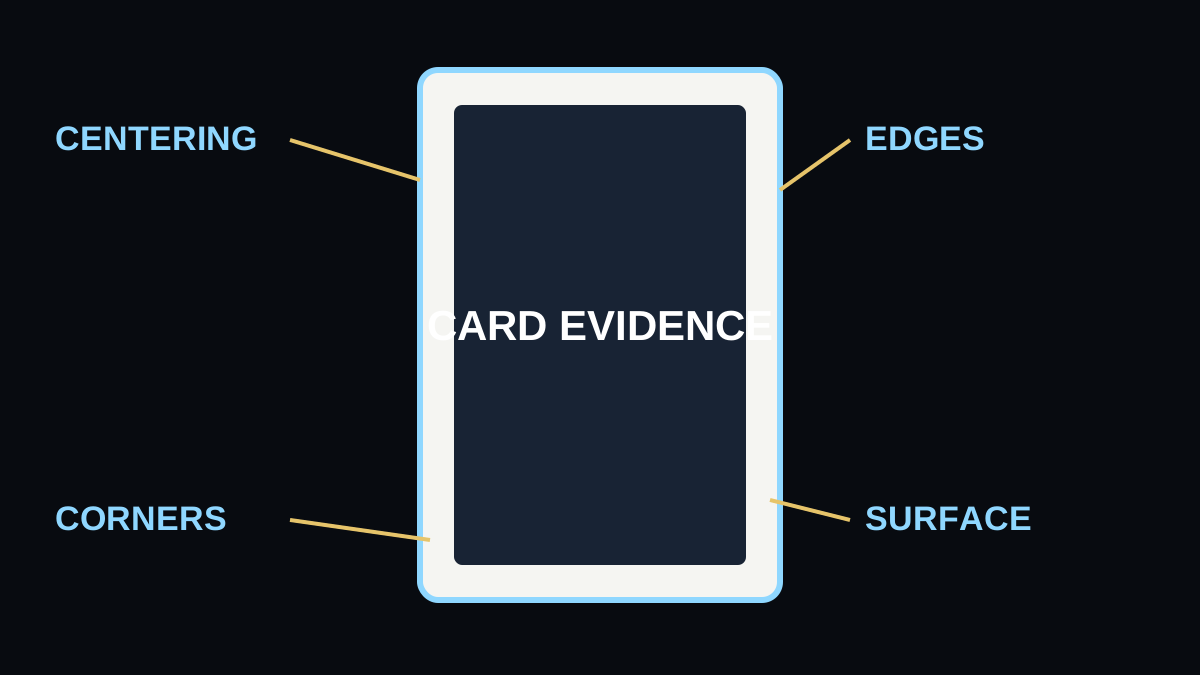
A trading-card grade is easiest to understand when it is broken into observable evidence. Four categories dominate condition analysis: centering, corners, edges and surface.
1. Centering
Centering compares the visible borders and printed design geometry. A strong analysis should evaluate left-to-right and top-to-bottom relationships on both sides rather than relying only on a quick visual impression.
2. Corners
Inspect each corner independently. Look for whitening, rounding, compression, fraying, bends and print-related irregularities. High-resolution close-ups make small defects easier to document consistently.
3. Edges
Edges can reveal chipping, rough cuts, whitening, dents and localized wear. Lighting angle matters because some defects are easy to miss under flat illumination.
4. Surface
Surface review looks for scratches, indentations, print defects, stains, creases and other disturbances. Multiple lighting angles can reveal features that a single straight-on photograph does not.
Why evidence matters
A number by itself tells a collector very little about how the conclusion was reached. CardDNA is designed around an evidence-first approach: preserve useful imagery, measurements and subgrade information so the final result can be reviewed rather than treated as a black box.